





Internal Micrometer Set
 Feb 06, 2026|
 product key technologies
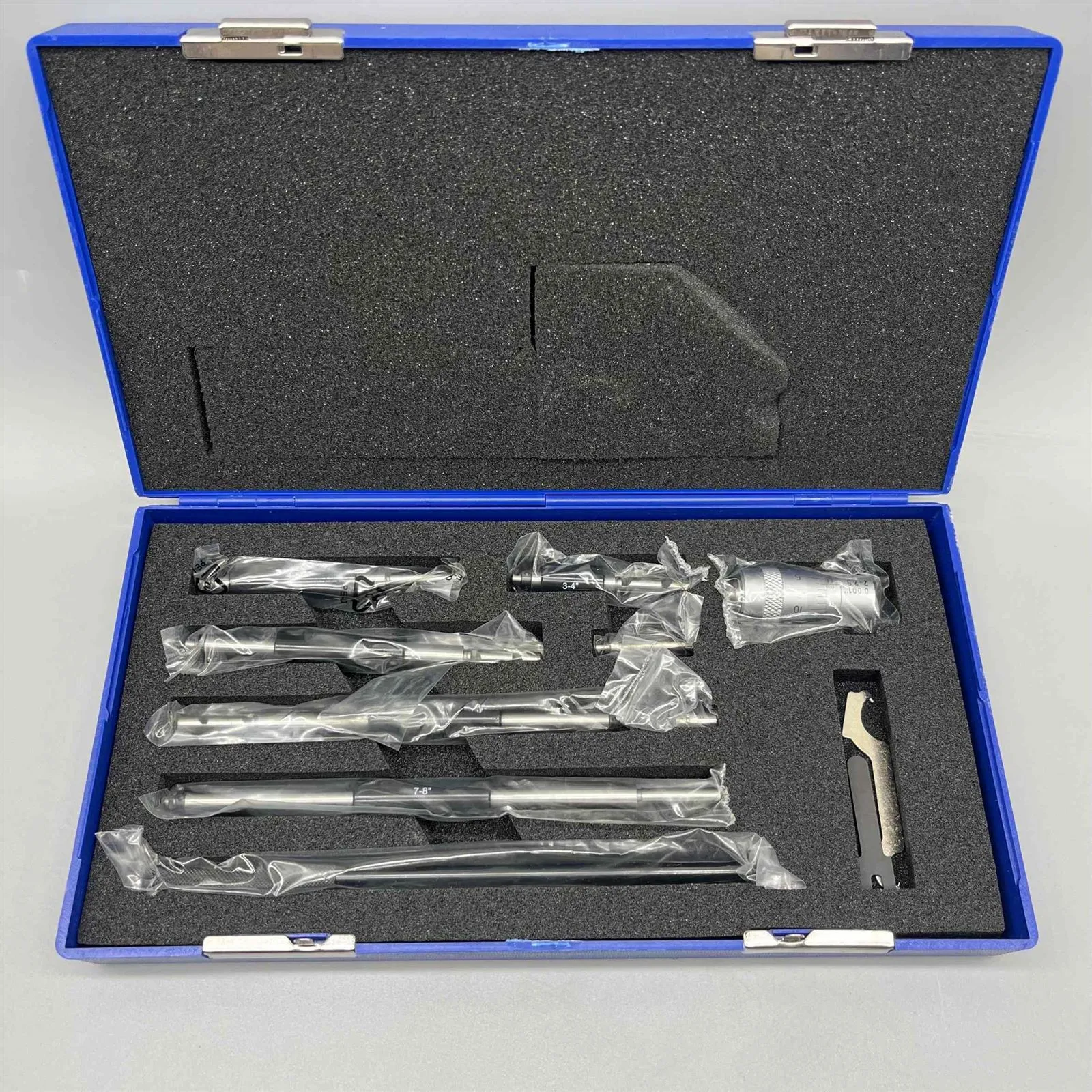
The extendable internal micrometer set is a precision modular measuring tool designed for measuring large-diameter and deep-hole internal dimensions in industrial applications. By combining the main micrometer head with extension rods of different specifications, it can achieve high-precision measurements of internal diameters, groove widths, and hole spacing ranging from tens of millimeters to several meters. Its accuracy meets the stringent requirements of mechanical manufacturing, precision machining, and equipment maintenance. It is widely used in industries such as automotive, aerospace, power generation, construction machinery, and pipe manufacturing. It is one of the core precision tools for measuring large internal diameters.
The core advantage of this tool lies in its modular design. A single micrometer head can be paired with multiple extension rods to flexibly expand the measuring range, replacing multiple fixed-range measuring tools. It combines practicality and cost-effectiveness while retaining the high-precision characteristics of a micrometer, distinguishing it from ordinary bore gauges, inside calipers, and other rough measuring tools.
Structural Composition:
The extension-rod type inside micrometer features a modular design, with all components connected by precision threaded joints to ensure coaxiality and measurement accuracy. The core components include the micrometer head, extension rods, measuring contacts, and a fixed measuring head. Some digital models are also equipped with auxiliary components such as an electronic display unit, a locking mechanism, and a force-measuring device.
Working Principle:
The core working principle of the extension-rod type inside micrometer is based on the screw pair transmission mechanism. Combined with the range extension provided by modular extension rods, it enables the measurement of large internal diameters. Its core measurement and reading logic are as follows:
Screw Pair Transmission:
The precision screw pair inside the micrometer head converts the rotational motion of the thimble into the linear reciprocating motion of the movable measuring probe. The pitch of a conventional screw pair is 0.5 mm, meaning that for every full revolution of the thimble, the movable probe moves 0.5 mm along the axial direction.


Range Extension:
By connecting extension rods of different lengths to the measuring end of the micrometer head, the basic measuring range of the micrometer head (typically 0–25 mm or 25–50 mm) is extended. The total length of the extension rods forms a fixed range, while the micrometer head provides fine adjustment within its basic range. This achieves a combined measurement of "fixed range + fine adjustment range." The final measured dimension equals the total length of the extension rods plus the fine adjustment reading of the micrometer head.
Reading Logic :
Taking the mechanical scale type as an example, the reading process consists of three steps.
First, read the integer and 0.5 mm values on the sleeve-that is, the largest whole-number graduation visible on the sleeve. If the 0.5 mm mark is exposed, add 0.5 mm.
Next, read the decimal value on the thimble-that is, the graduation line aligned with the sleeve's reference line-then multiply it by 0.01 mm.
Finally, add these two values together, and then add the total length of the extension rods to obtain the final measured dimension.
Force Control:
The ratchet force-control device limits the torque transmitted through the screw pair by allowing controlled slipping, ensuring a consistent contact force (1.5–2 N) between the measuring contacts and the workpiece during each measurement. This prevents deformation of the workpiece or measuring surfaces due to excessive force and avoids inaccurate readings caused by insufficient contact force, thereby reducing human-induced measurement error.
Operating a internal micrometer set is more complex than operating a regular outside micrometer or a small-range inside micrometer. The correctness of the operation directly affects measurement accuracy. It is essential to strictly follow the steps of "Preparation - Assembly - Calibration - Measurement - Reading - Finishing". Detailed operational steps are as follows:

1. Cleaning: Use degreased cotton soaked in anhydrous ethanol or aviation kerosene to carefully wipe the fixed sleeve, micrometer barrel, measuring surfaces, and the threads and measuring contacts at both ends of the extension rod. Simultaneously wipe the inner surface of the workpiece being measured to remove oil, iron filings, dust, and other impurities, preventing these from affecting the contact of the measuring surfaces and causing reading errors.
2. Extension Rod Assembly: Based on the estimated inner diameter of the workpiece being measured, select an extension rod of appropriate length, following the principle of "larger to smaller, sequential connection". That is, first connect the longest extension rod to the movable measuring tip of the micrometer, then connect the shorter extension rods in sequence, and finally install the measuring contacts. When connecting, gently tighten the threads by hand, avoiding the use of tools to strike or overtighten, to prevent thread stripping or misalignment of the connecting rod. After tightening, check that the connecting rod is aligned with the micrometer head axis and is free from bending or looseness.
3. Baseline Calibration (Zeroing): Calibration is a crucial step in ensuring measurement accuracy. Zeroing adjustment must be performed using a standard ring gauge or calibration bar. Place the assembled micrometer into the standard ring gauge (or calibration bar), and gently rotate the micrometer tumbler until the measuring surface is in close contact with the inner wall of the standard ring gauge. Simultaneously, gently wiggle the micrometer to find the position with the tightest fit. Then, rotate the zeroing nut of the micrometer tumbler until the baseline of the fixed sleeve is aligned with the 0 mark on the micrometer tumbler, completing the zeroing process. For digital display models, simply press the zeroing button for easier operation.
4. Equipment Inspection: Check if the micrometer head's tumbler rotates smoothly without jamming or abnormal noise; check if the locking device effectively secures the moving probe; check the extension rod's threads for stripping or damage; check the measuring surfaces for scratches or wear. Minor wear can be compensated for through calibration; severe wear requires immediate replacement.
5. Inserting the Workpiece: Slowly insert the assembled micrometer into the inner hole to be measured, avoiding collisions between the measuring probe and the workpiece's inner wall, which could damage the measuring surfaces or deform the extension rod; after insertion, adjust the micrometer's axis to ensure it coincides with the axis of the inner hole being measured, minimizing skew errors.
6. Fine-tuning to find the maximum value: Gently rotate the ratchet of the micrometer tumbler by hand, slowly moving the measuring probe towards the inner wall of the workpiece until the ratchet slips, indicating that the measuring surface is in close contact with the inner wall of the workpiece. At this point, gently swing the micrometer left and right, and up and down to slowly adjust its position and find the maximum value of the measured reading. This maximum value is the actual inner diameter of the measured inner hole (due to slight roundness errors in the inner hole, the maximum value is the true hole diameter).
7. Fixing the reading: After finding the maximum hole diameter, immediately engage the locking device to fix the position of the movable probe, preventing movement of the movable probe during the removal of the micrometer and causing reading deviations.
8. Multi-position measurement of internal micrometer set: To eliminate shape errors (such as roundness and cylindricity errors) in the workpiece, multi-position measurement is required. Along the axial direction of the inner hole being measured, select three sections: front, middle, and back. Measure once in each of the two mutually perpendicular radial directions (e.g., horizontal and vertical) for each section. Record all measured values, and finally take the average value as the final size of the measured inner hole. The average value can effectively reduce the measurement deviation caused by shape errors.