




How to measure the length of a curve with digital calipers approximately?
 Sep 03, 2025|
 Measuring the length of a curve accurately is a common challenge in various fields, such as engineering, manufacturing, and scientific research. While digital calipers are typically used for measuring straight - line dimensions, they can also be employed to approximate the length of a curve. As a digital calipers supplier, I'd like to share some practical methods and considerations on how to achieve this.
1. Understanding the Limitations of Digital Calipers for Curve Measurement
Digital calipers are designed primarily for linear measurements. They provide precise readings of distances between two opposite points. When it comes to measuring a curve, the fundamental issue is that a curve is not a straight line. The measurement obtained with digital calipers will always be an approximation because we are essentially breaking the curve into small straight - line segments.
The accuracy of the approximation depends on several factors. Firstly, the resolution of the digital caliper matters. A caliper with a higher resolution (e.g., 0.01 mm) will generally provide a more accurate approximation compared to one with a lower resolution (e.g., 0.1 mm). Secondly, the number of segments into which the curve is divided affects the accuracy. The more segments we use, the closer the sum of the lengths of these segments will be to the actual length of the curve.
2. Step - by - Step Method for Approximating Curve Length
Step 1: Select the Right Digital Caliper
As a digital calipers supplier, I recommend choosing a high - quality caliper that suits your measurement needs. For example, the Precision Digital Caliper offers excellent accuracy and reliability. It has a clear digital display that makes reading measurements easy, and its precision mechanism ensures consistent results.
If you need a caliper that can withstand harsh environments, the Stainless Steel Digital Vernier Caliper is a great option. Its stainless - steel construction makes it resistant to corrosion and wear, which is important when working in industrial settings. Another choice is the Ip54 Digital Caliper, which has an IP54 rating, meaning it is protected against dust and splashing water.
Step 2: Prepare the Curve for Measurement
Before starting the measurement, make sure the curve is clean and free from any debris that could affect the accuracy of the caliper's jaws. If the curve is part of a larger object, secure the object firmly so that it does not move during the measurement process.
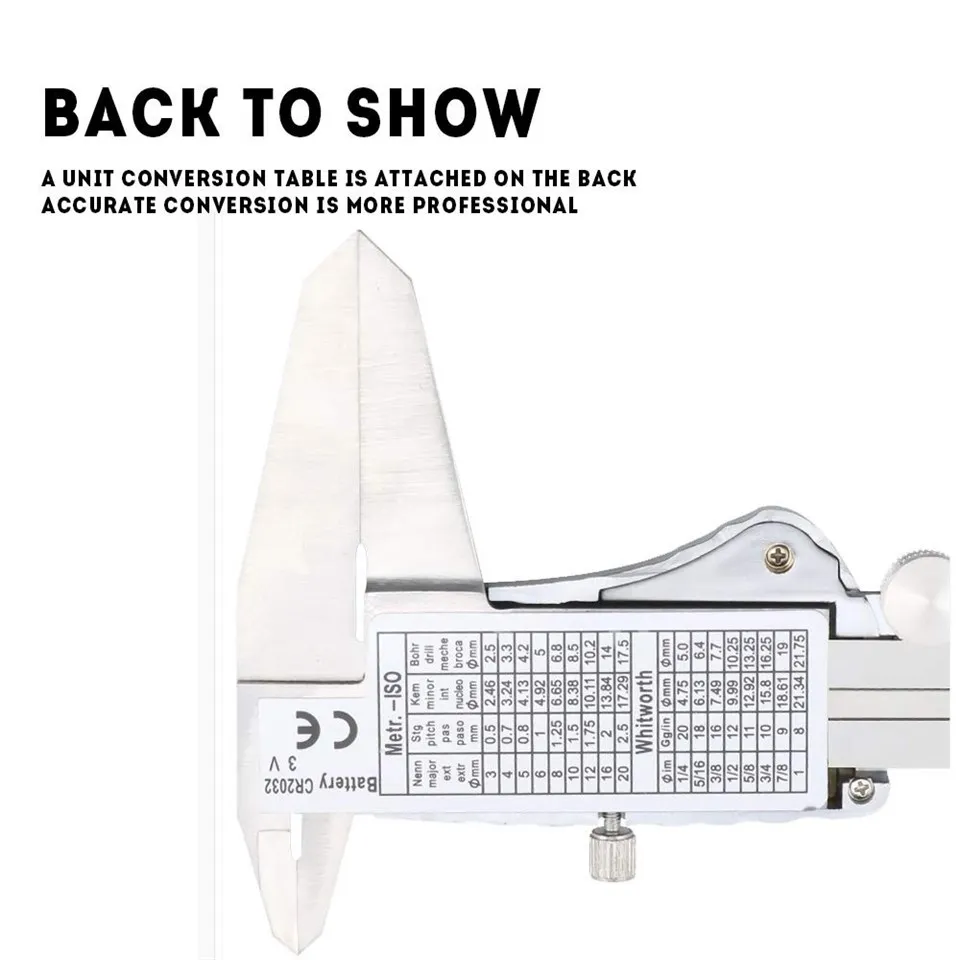

Step 3: Divide the Curve into Segments
Visually divide the curve into a series of small straight - line segments. The smaller the segments, the more accurate the approximation will be. For a smooth curve, you can use a ruler or a straight edge to help you draw the segments on the curve. Try to make the segments as short as possible while still being able to measure them with the caliper.
Step 4: Measure Each Segment
Open the jaws of the digital caliper and place them at the two endpoints of each straight - line segment. Make sure the jaws are perpendicular to the segment for an accurate measurement. Press the "zero" button on the caliper if necessary to set the initial reading to zero. Read the measurement displayed on the caliper and record it. Repeat this process for each segment of the curve.
Step 5: Calculate the Total Length
Once you have measured all the segments, add up the lengths of these segments. The sum of these lengths is an approximation of the length of the curve. For example, if you have measured five segments with lengths (l_1, l_2, l_3, l_4,) and (l_5), the approximate length (L) of the curve is (L=l_1 + l_2 + l_3 + l_4 + l_5).
3. Tips for Improving the Accuracy of Curve Measurement
- Use a Smaller Segment Size: As mentioned earlier, reducing the size of the segments will improve the accuracy of the approximation. However, be aware that using extremely small segments may increase the measurement time and the potential for errors due to the difficulty of placing the caliper jaws precisely.
- Take Multiple Measurements: To account for any measurement errors, take multiple sets of measurements for each segment and calculate the average. This can help reduce the impact of random errors.
- Use a Magnifying Glass: If the curve is very small or the segments are difficult to measure accurately, a magnifying glass can be used to help you place the caliper jaws more precisely.
4. Applications of Curve Length Measurement with Digital Calipers
- Engineering and Manufacturing: In mechanical engineering, measuring the length of a curved part, such as a cam or a spring, is crucial for ensuring proper fit and function. Digital calipers can be used to quickly approximate the length of these curves during the design and quality - control processes.
- Art and Design: Artists and designers may need to measure the length of curved lines in their works. Digital calipers can provide a simple and relatively accurate way to do this, especially when working on projects that require precise dimensions.
- Scientific Research: In fields such as biology and geology, measuring the length of curved objects, like the contour of a cell or a rock formation, can provide valuable data. Digital calipers can be a useful tool for these types of measurements.
5. Conclusion and Call to Action
In conclusion, while digital calipers are not designed specifically for measuring curves, they can be effectively used to approximate the length of a curve. By following the steps outlined above and using the right digital caliper, you can obtain reasonably accurate results.
As a digital calipers supplier, we offer a wide range of high - quality digital calipers to meet your measurement needs. Whether you are an engineer, an artist, or a researcher, our calipers can provide the precision and reliability you require. If you are interested in purchasing digital calipers or have any questions about curve measurement, please feel free to contact us for further discussion and procurement. We look forward to working with you to find the best solutions for your measurement challenges.
References
- "Measurement and Instrumentation Principles" by Alan S. Morris.
- "Engineering Metrology" by R. K. Jain.